Tribute to the Life and Legacy of Artist Yayoi Kusama

Updated: 6 hours ago

Artwork by Yoyoi Kusama
Japanese avant garde artist Yayoi Kusama, known for her preponderance of polka dots, bold colors, and repeating patterns, recently passed away at the age of 97 years old. She leaves a massive imprint on the contemporary art world including painting, interior, fashion, graphic, and architectural design. She essentially shifted the design paradigm from passive viewing to immersive, multisensory experiences, bridging the gap between fine art and everyday life.
Experiential & Spatial Design

Artwork by Yoyoi Kasuma
The "Infinity Rooms: Decades before the rise of social media, Kusama’s 1965 Infinity Mirror Rooms pioneered experiential space design. Modern retail spaces, museum pop-ups, and experiential branding agencies heavily rely on her formula—mirrors, lighting, and repeating elements—to design interactive, highly shareable environments.
Architectural Takeovers: Kusama normalized the concept of blurring the lines between structural architecture and art installation. Her monumental storefront takeovers, such as wrapping entire flagship buildings in massive polka dots, have heavily influenced modern spatial marketing and temporary architecture.
High Fashion & Streetwear
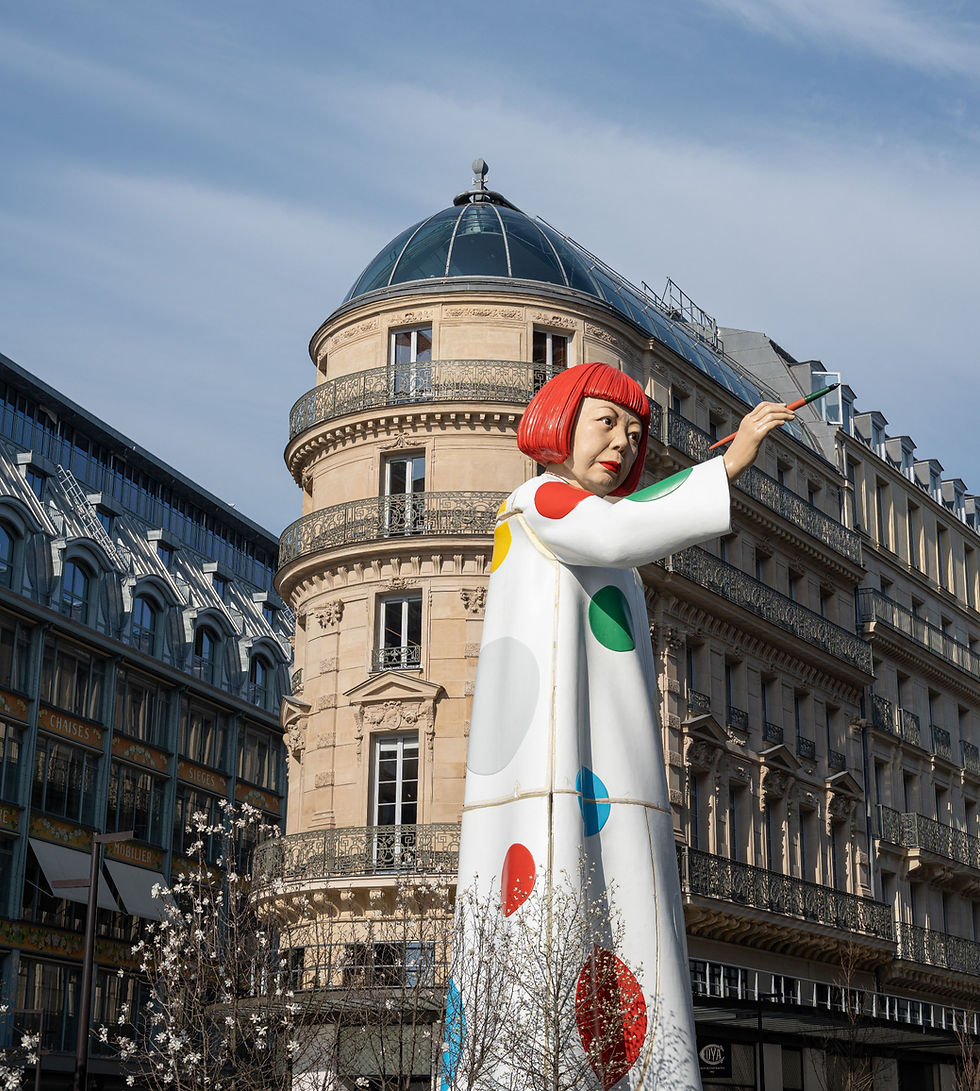
Sculpture of artist Yoyoi Kusama
Luxury Collaborations: Her historic, monumental partnerships with Louis Vuitton (in 2012 and 2023) completely rewritten the rules for artist-brand crossovers. She proved that avant-garde fine art could be adapted into commercial high-fashion patterns for luxury leather goods, ready-to-wear lines, and footwear.
The Avant-Garde Silhouette: Her short-lived 1960s fashion line, "Kusama Fashion Company," featured experimental, body-conscious silhouettes with tactical cut-outs. Her emphasis on garments behaving as "interactive spaces" for the human form paved the way for modern, rebellious streetwear designs.
Graphic, Textile, & Product Design

Artwork by Yoyoi Kasuma
Elevated Pattern-Making: Kusama took the humble polka dot—historically viewed in design as a simple, playful fabric pattern—and re-coded it into a premium graphic motif representing infinity and mathematical precision.
Japandi & Minimalist Decor: While her art is inherently maximalist, her focus on repeating natural organic geometry (like the rhythmic ribs of her pumpkins or delicate mesh grids) has influenced modern textile designers. Elements of her work are frequently integrated to add punchy, abstract focal points to modern, Japandi, and minimalist living areas.
About Yoyoi Kusama
Avant-garde artist, novelist Yayoi Kusama was born in 1929, in Matsumoto City, Japan. From childhood she experienced visions and hallucinations, which engendered her first polka-dot and net-themed drawings. Using watercolors, pastels, and oil paints, she developed her own unique form of expression at an early age. Kusama relocated to the United States in 1957. The following year, while based in New York City, she began exhibiting innovative works in rapid succession, including net paintings, soft sculptures, and installations employing mirrors and lights.
She formulated a philosophy of art she dubbed “self-obliteration” based on simple motifs of obsessive repetition and proliferation. The scope of her activities widened to include body painting events, fashion shows, anti-war “happenings,” films, and newsletters, helping to establish her status as a leading avant-garde artist. After returning to Japan in 1973, she resumed writing fiction and poetry and created outdoor sculptures, large-scale installations, and the “Infinity Mirror Room” series. In 2009, she began work on her “My Eternal Soul” series, which continued until 2021, by which time she had produced roughly 900 paintings. In 2021, she began work on a new series, “Every Day I Pray for Love.” The Yayoi Kusama Museum opened in Tokyo in 2017.


The Beverly Arts News is sponsored by Art Hearts Fashion, Mogo, MDSUN, Shennel Trading, XAVVI, ISEGSTAR, World Peace One, Crab Grabber, InLight Foundation, Jiannan Huang Art Institute, Yi Ke Art in Beverly, Wenkang Xue Design Studio, and The Beverly Arts Foundation